Photography --- January 2006 --- USA
After using the PowerShot S2 IS along side my EOS 300 for six weeks in Africa and London, I came up with the following list of advantages and disadvantages of the S2.
Advantages
Easier to take stealth shots
Can voice annotate photos
Take pictures of maps, record phone numbers, copy directions, etc. and have
all the information handy
Show people their picture right after you take it (kids love this)
Take a ton of shots without worrying about wasting film
Instant feedback on composition and exposure allows me to improve the shot
Exposure settings, date and time are automatically recorded for every shot
Huge zoom range, image stabilization and excellent macro make this an
all-in-one camera
Ability to change ISO settings any time is awesome, though the camera gets
noise at speeds as slow as ISO 100 and won't go faster than ISO 400
Fits a ton of photos on a postage stamp size SD card
Uses easy to find AA batteries -- get NiMH rechargeables and a set of lithium batteries for cold conditions
Since my computer is my primary photo album these days, I prefer digital images.
Scanning prints or negatives is a hassle and degrades quality
Cost savings in the long run by not buying and developing film
Disadvantages
LCD screen and viewfinder not nearly as good as an SLR -- can't see where the
camera has focused
Manual focus is nearly useless, even with focus bracketing enabled
Focuses fairly fast, but not as fast as my SLR. Low light focusing is very good
The friction attached lens cap tends to fall off
Impossible to get a really shallow depth of field
Smallest aperture is f8
Uses batteries much faster than an SLR
Overall the S2 IS is a great travel camera. The quality is excellent and the image stabilization really helps nail shots. I can't imagine getting more features in a smaller package. This 20 ounce package could literally be the only camera equipment you need for an around the world trip. However, the fact that you can't see the focus setting until reviewing the picture means that you shouldn't use it for once in a lifetime shots. Photographing wildlife -- where it is crucial to have quick reliable focus, a fast lens, and less noise at higher ISO settings -- is not this camera's forte. Similarly the camera is lacking for any shot where you need shallow depth of field. Otherwise it is equal to or better than my SLR.
Took a series of test photos with my cameras to see which lens/aperture combination takes the sharpest pictures. The Canon 300mm zoom at f16 takes the best shots, followed closely by the Canon 80mm zoom at f16. The Sigma lens takes excellent photos but at a smidge lower quality. I was surprised to see that f16 was very noticeably better than f8 with all lenses. The S2 takes the sharpest pictures at f5.6 which is the middle of its aperture range. The SX110 takes sharpest pictures with the aperture open, around f4.0 or f4.5, not at the middle of the range. For ISO settings, the SX110 does best at 80, but 100 is virtually as good. ISO 200 is still quite good. 400 is noticably noisy but the pictures are still usable. ISO 800 and 1600 are too noisy to be of any use.
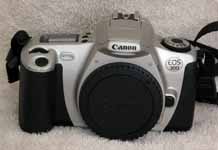
|
Canon EOS 300 Film SLR Ithaca -- 1/27/2006 |
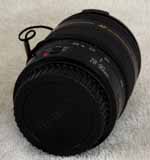
|
Canon 28-80 USM F3.5/5.6 Ithaca -- 1/27/2006 |
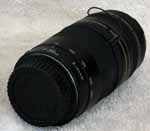
|
Canon 75-300 USM F4/5.6 Ithaca -- 1/27/2006 |
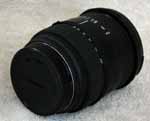
|
Sigma 28-200 USM F3.5/5.6 Ithaca -- 1/27/2006 |
|
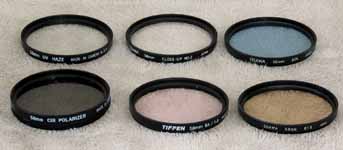
My 58mm filters (for the Canon lenses). UV, Closeup #2, Circular Polarizer, Skylight, 82A, 81B. I don't carry the filters often these days, mostly out of laziness. They do improve shots when used at appropriate times. Ithaca -- 1/27/2006 |
|
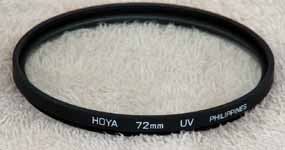
My one 72mm filter (for the Sigma lens). A good quality Hoya UV filter. Ithaca -- 1/27/2006 |
|
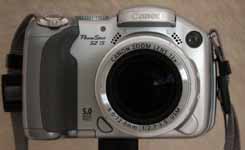
Canon PowerShot S2 IS 5MP Digital Ithaca -- 1/27/2006 |
|
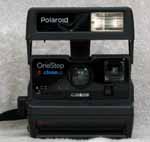
Polaroid instant camera. I got this in a white elephant gift exchange. Kinda fun! Ithaca -- 1/27/2006 |
|
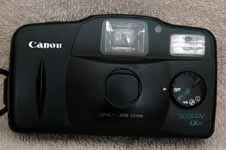
Canon snappy film camera. Film is a real hassle, but sometimes you don't want to drag a good digital camera up a rock climb. Though in reality I never use this camera. Ithaca -- 1/27/2006 |
|
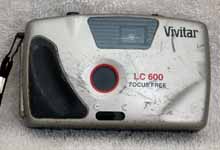
Vivitar fully manual film camera. I've dragged this up a few rock climbs, and it really shows. Ithaca -- 1/27/2006 |
|
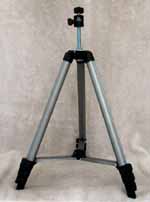
This is an ultralight tripod I made myself out of a set of cheap tripod legs and a Giotto MH-1004 ball head. The tripod extends to 48" maximum height. Two of the three tripod braces are held on with cotter pins. When the pins are removed the legs go flat and the ball head sits just 6" off the ground. The ball head is mounted on a bolt which is long enough to allow a camera to swing into vertical orientation without hitting the tripod legs. The whole thing weighs 20 ounces. It is stable enough for my digital camera and even the SLR with a small lens. I can use the tripod with my SLR and a big lens, but the camera needs a bit of manual support to keep from shifting. Ithaca -- 1/27/2006 |
|
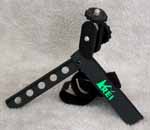
Ultrapod mini tripod. Only weighs 1.5 ounces. It is easily stable enough for my digital camera and will even hold the SLR with a small lens if there is no wind. The tripod has a velcro strap which allows it to be attached to small tree branches and treking poles. Ithaca -- 1/27/2006 |
|
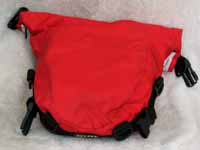
Sundog water resistant camera bag. The inner padded bag can be used by itself, which is what I normally do unless I expect wet conditions. Ithaca -- 1/27/2006 |
|
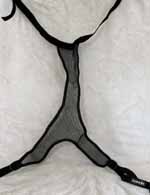
Sundog harness. Can be used with the bag or attached directly to a camera. Ithaca -- 1/27/2006 |
|
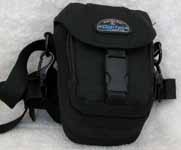
Tamrac 5693 case for the PowerShot. I added a foam cutout which fits in the font pocket. It provides extra padding and secure storage for an extra set of AA batteries with room for a few extra SD cards. Ithaca -- 1/27/2006 |
|
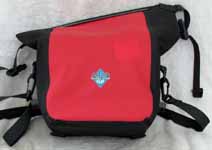
Ortlieb waterproof camera case. Enough room for an SLR, three lenses, and assorted supplies. Ithaca -- 1/27/2006 |
|
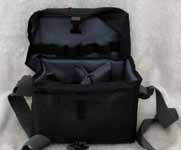
A camera bag I got for $1 at Salvation Army. Handy for transporting extra equipment when I'm not traveling light. Ithaca -- 1/27/2006 |
|
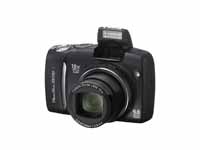
Stock photo of the Canon SX110. When that broke, I upgraded to the SX120 which is virtually identical. Except Canon dumbed down the firmware... It only has two resolution settings and the voice memo feature was eliminated. Ithaca -- 12/18/2008 |